
In micro injection moulding, size, tolerance, rheology, gate and part handling require specific validation before series production.
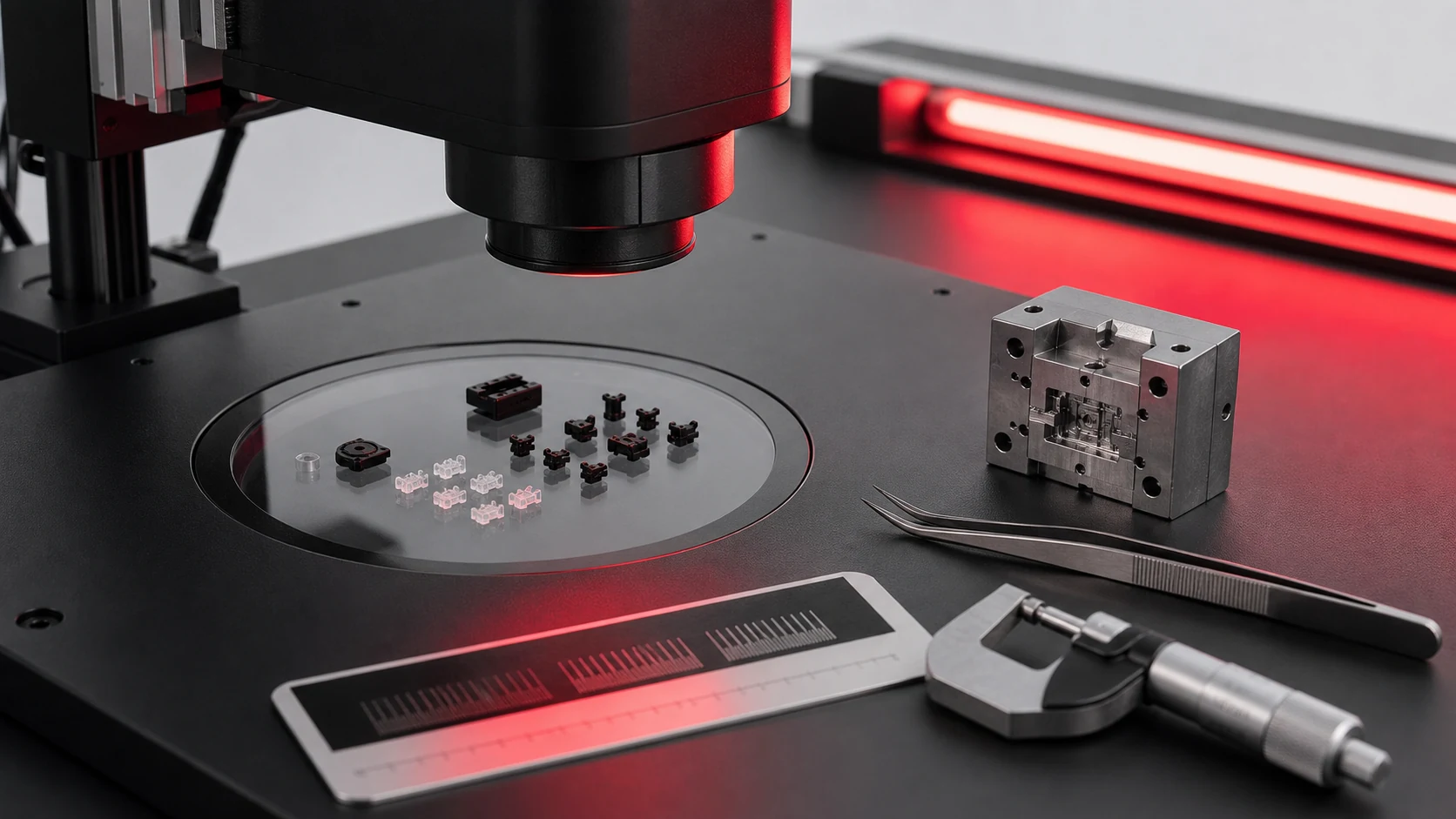
Key idea: the prototype must answer a specific technical question, not only produce a visible part.
Scale changes the rules
In micro injection moulding, the gate, flash, venting and handling occupy a relevant share of the geometry. A variation that would be acceptable in a larger part can close a passage, distort a flexible feature or prevent assembly.
Validation starts by defining functional dimensions, shut-off surfaces, contact areas and the measurement method. The goal is not a visually acceptable small part, but evidence that the process can repeatedly deliver the features that matter.
Scaling down a large design is not enough
Reducing a geometry without reviewing walls, radii, ribs and transitions increases pressure loss and filling sensitivity. Material, flow length and gate location must be assessed together: a small gate change can alter orientation, packing and functional flash.
Ejection needs the same rigour. Very small support points, cavity vacuum or a flexible part can mark or damage the component before inspection. The prototype must reveal these interactions with the intended resin, rather than only proving that the CAD fits the tool.
Define a process window
A valid first cycle does not demonstrate robustness. Trials should vary melt and mould temperature, speed, holding pressure and cycle time within a realistic range, recording which conditions affect filling, appearance and critical dimensions.
The outcome should separate symptoms from causes. Short shots, flash, dimensional spread or handling damage may call for different changes to geometry, venting, gate, cooling or process conditions. This evidence helps identify what will transfer to production tooling.
Measurement and handling are part of the design
Before trials, define the datum, equipment resolution, sample size and stabilisation time after ejection. Measuring a dimension that evolves through shrinkage or relaxation can lead to the wrong decision.
The method for removing, transporting and presenting the part for measurement or assembly must also be validated. If a gripper, operator or vision system adds damage or variation, the risk remains even when the tool fills correctly.
What the prototype must prove
Validation should provide evidence of dimensional repeatability, complete filling, no functional flash and a viable inspection method. Acceptance criteria must relate to final function, not only to the appearance of one sample.
- Filling and venting: check distant areas and section changes without operating at a process extreme.
- Gate and packing: review vestige, orientation and impact on functional dimensions.
- Ejection and handling: verify that demoulding and collection do not mark or distort parts.
- Measurement: set datums and enough repeats to distinguish true variation from measurement noise.
Decide with evidence before series production
If the prototype needs an extreme setting to fill, shows spread in a functional dimension or does not allow repeatable inspection, the response may be to redesign the part, move the gate, reinforce the shut-off or revise handling. Anticipating these decisions reduces uncertainty before committing production tooling.
Frequently asked questions about micro injection
Is micro injection only smaller injection moulding?
No. At micro scale, gate, flash, venting, handling and measurement have a much greater influence on feasibility.
Which risks appear in micro-injected parts?
Incomplete filling, functional flash, handling damage, dimensional spread and difficulty defining repeatable inspection criteria.
What must the prototype prove?
Dimensional repeatability, complete filling, absence of functional flash and a viable inspection method for series.